Multilingual AI Publishing: Scaling Content Across English, Chinese, and Vietnamese

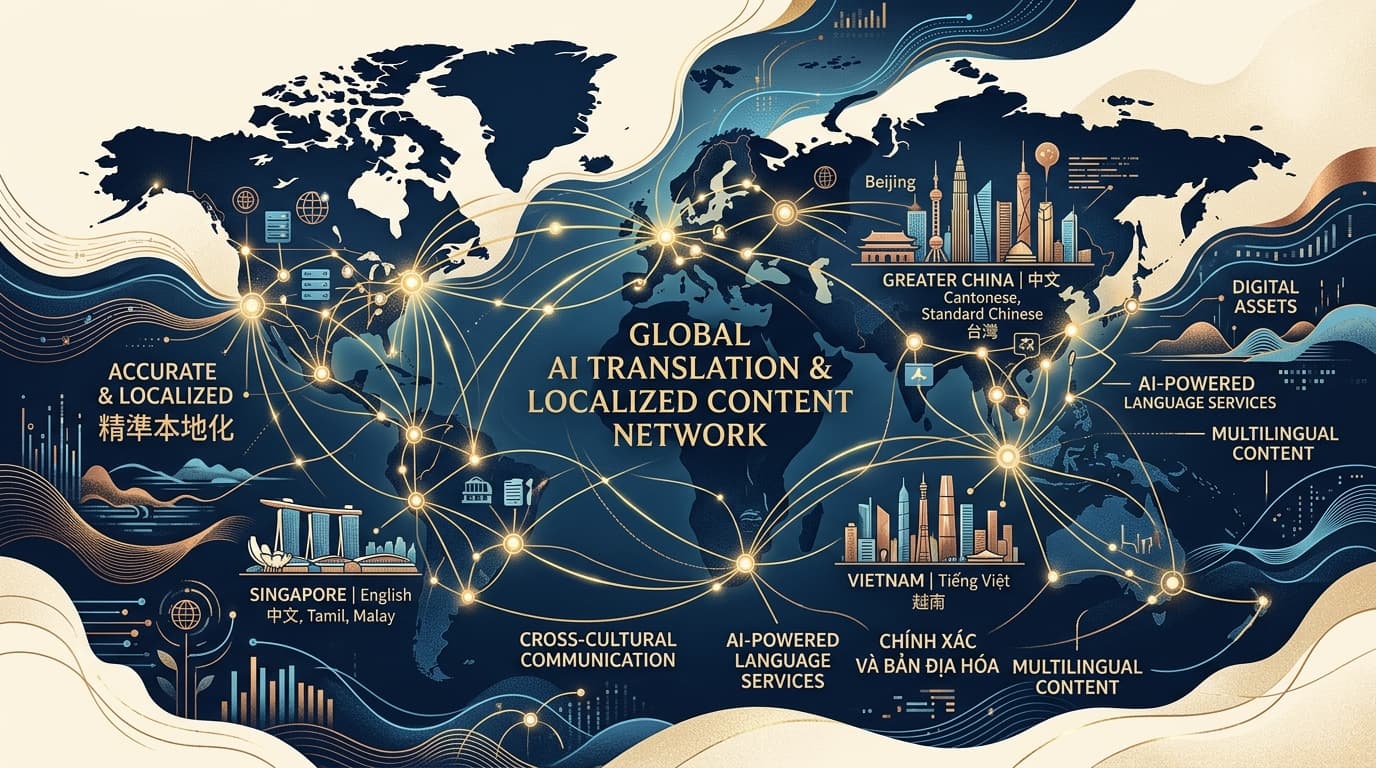
Operating across Southeast Asia requires serving linguistic diversity as a primary capability, not an afterthought. For businesses expanding between Singapore, Greater China, and Vietnam, traditional translation agencies create severe bottlenecks: slow turnarounds, exorbitant word-count fees, and inconsistent brand voice.
What makes AI-driven localization different from machine translation?
Traditional translation tools like Google Translate translate sentence-by-sentence in isolation. An AI-native localization pipeline uses contextual LLMs that preserve brand nuance, technical domain terminology, and cultural context.
- Brand Glossary Enforcement: Automatically injecting approved terminology and local regulatory phrasing.
- Synchronized Multilingual Static Site Publishing: When an article is authored or updated in one language, translations are compiled, verified, and published simultaneously across
/articles,/zh/articles, and/vi/articles. - Structured Data Localization: Aligning
inLanguage, schema attributes, and canonical alternates for maximum international SEO.
Measurable Results
In our client deployments across financial services and B2B platforms:
- Turnaround Speed: 10,000 words published across 3 languages in 4 hours vs. 2 weeks.
- Cost Reduction: 85% lower per-word cost compared to traditional translation agencies.
- Search Visibility: 3.4x higher organic regional impressions through localized schema and native slug indexing.
Deploy AI inside your business
Four operators from Google, Meta, AWS and McKinsey. We train your team, run your content engine, and automate your workflows with zero handoffs.
Tell us what's slowing you down →